Showing posts with label Africa. Show all posts

14 October 2012

Black mamba venom may be a super painkiller!

French scientists have recently identified that the toxic venom of the black mamba, one of Africa's most dangerous and feared snakes, has a huge potential for its use in medicine. The research, carried out by Dr. Eric Lingueglia from the Institute of Molecular and Cellular Pharmacology near Nice, has identified that the snake's poison contains a unique class of chemicals called mambalgins, which act as painkillers in mice that are as strong as morphine but have none of its associated side effects.

The black mamba, Dendroaspis polylepis, is named after the dark skin inside its mouth rather than after the colour of its scales. As well as being among the most poisonous snakes in the world, the 3 metre long mamba is also the fastest and can even outrun humans. These attributes, along with its highly aggressive nature, have made the snake highly feared among all the African peoples that live alongside it.

These properties of black mamba venom are of huge interest to the healthcare sector because, despite its heavy use, morphine is highly addictive and has many severe side effects for those taking the drug, which include headaches, a reduction in their thinking capacity, nausea and muscle spasms. A new painkiller then, which is effective enough to remove the same agonising pains as morphine but with none of its side effects would be like a 'magic bullet' in pharmacology, being hugely popular among both doctors and their patients.

Research has identified that these useful mambalgins may work in such a beneficial way because they operate via a previously unseen neural pathway that is not targeted by any other studied venom or by the palliative drugs currently in production. Dr. Nicholas Casewell, a world-leading expert in snake venom from the Liverpool School of Tropical Medicine, is avid over the potential implications of black mamba toxins to medicine and has said that mambalgins are "a really great example of drugs from venom, we're talking about an entirely new class of analgesics".

Dr. Lingueglia believes that this rather surprising property of black mamba venom may be as an intentional effect of the poison, which helps to incapacitate the snake's prey so that it is less likely to escape; or may be due to a chance, but useful, fluke in mice, resulting from the differences in brain chemistry between the rodents and the snake's usual prey.

Whatever the reason for the venom's remarkable analgesic properties in mice however, scientists are excited about the discovery and are hopeful that the toxins will have the same effects in humans as our brain chemistry is very similar to that of the rodents (which is why mice are often used in scientific studies). It is likely that there will be extensive research into mambalgins in the near future, which will hopefully lead to a new drug that acts as a safer alternative to morphine.

10 October 2012

From black to white: is calcium really that important?

The majority of us are at ease with Darwin's concept of evolution and understand how the 'survival of the fittest' has led to the vast abundance of life on Earth. Obviously, humans are no exception to this rule and evolution has moulded us into what we are today. Evolution, for example, selected for the first of us who began to move on two legs as this freed up our hands for better tool use; and selected for those who chose to live in social groups, which provided much more protection and help than did living alone. Without evolution it is doubtful that any life would exist on Earth at all, especially not in the form of hugely sophisticated organisms like humans.

Life on Earth began sometime around 4 billion years ago. It is believed that single-celled organisms first evolved on the shores of primordial oceans, which were abundant in the resources needed for life. Over time, these cells eventually evolved into the countless forms of life that we see on Earth today.

Most of you won't be surprised by any of this; it makes sense, after all. Something you might find surprising however, is why scientists believe that the early humans settling Europe evolved from being black to white. Obviously the sun's rays are less intense in Europe than they are in Africa, meaning that European settlers wouldn't have needed to produce as much of the pigment melanin in their skin, which absorbs ultraviolet (UV) radiation. Producing less melanin then would have provided such individuals with an advantage as they wouldn't have been wasting energy producing proteins their body didn't really need. This saved energy could then have been dedicated to more important processes (like keeping warm in the colder climate, for one thing).

Although this theory makes sense logically and saving energy by producing less melanin could quite plausibly have been the difference between life and death in the harsh European winters, is it really enough to have driven the evolution of one of our most noticeable racial polymorphisms?

Many scientists believe not, at least not by itself anyway, and research into this question has provided a rather odd alternative. Simply put, many scientists now believe that Europeans evolved from having black skin to white skin due to calcium!

Calcium is an fundamental resource for our bodies, with its ions having essential roles in muscle contraction; in propagating nerve impulses; and, arguably most importantly, in forming our skeletons (via binding with phosphorous to form a very stable salt called calcium phosphate). Despite its importance, calcium is rare in nature and is extremely difficult to acquire naturally as part of our diets. As always however, Nature provided early man with an ingenious way around this and all humans are able to make vitamin D in their skin when it is exposed to sunlight (in much the same way as plants photosynthesise sugars from sunlight to use as energy). Vitamin D greatly increases the affinity of calcium absorption in the gut, allowing the body to absorb much more of any calcium that it consumed than it would otherwise be able to.

Due to this ability, most people are able to acquire enough calcium (especially during the summer) to lead normal and healthy lives, and indeed, our African ancestors would have had strong bones and efficient muscles. The problems arose however, when early explorers entered Europe where the sun's rays are much less intense. This meant that the melanin pigments in their black skin were able to absorb much more sunlight than they could while in Africa and, as a result, vitamin D could no longer be produced.

Fossil evidence suggests that it was not long before the health of these explorers deteriorated, and many adult skeletons from the period show symptoms of osteomalacia (a disease where bones soften due to lack of calcium and deform under the weight of walking), and many may have suffered from a range of muscle weakness and epileptic disorders as their reserves of calcium were depleted and less and less could be replaced from bone stripping. Obviously such ill effects greatly reduced an individual's chances of survival and those with slightly lighter skin would have been more likely to live longer. Being healthier and living longer meant that they would have been more likely to survive to reproduce and slowly, the 'lighter' genes (which produced less melanin), would have spread through the population. In each generation the palest individuals would have been most successful at surviving and breeding so, over time, European humans would have got paler and paler until their skin was as white as it is in their descendants now.

As if this selection pressure wasn't enough to drive for whiter skin, having low levels of calcium and brittle bones had another major problem for women in particular - it hindered childbirth. Many women had such brittle pelvises that they broke under the strain of labour, virtually guaranteeing that both the infant and the mother would die. Furthermore, many children suffered from severe rickets due to a lack of calcium during childhood and puberty. This meant that such individuals were physically smaller than they should have been and many women suffered from underdeveloped hips that were too narrow for a baby to pass through. As a result, such a mother and her baby would have died during labour. Thus, many of the darker individuals would have been unable to give birth so that the darker genes disappeared from the European populations very quickly - being strongly selected against by Nature!

The degree of deformity that rickets can lead to can be very extreme, almost completely debilitating a child suffering with the condition throughout their entire life.

Scientists also believe that this explains why the vast majority of Europeans (and those in their descendent colonies such as Australia and the USA) can eat dairy as a stable component of their diet. This is actually quite abnormal, both in the animal kingdom and among other ethnicities of humans, as rennin (the enzyme required to digest milk) usually stops being produced by the body in infancy after the individual has been fully weaned. Thus, most humans are lactose intolerant and experience unpleasant symptoms if they drink milk or eat too much dairy-based produce. Humans evolving in Europe however, needed as much calcium as possible and would have been under strong selection pressure to continue producing rennin throughout their lives as milk is an unrivalled source of calcium.

Thus, the importance of calcium to the human body has made it an invaluable component that we need to survive. Too little calcium leads to severe health conditions that are so extreme that they can even drive evolution into turning black humans, who have very active melanocytes (melanin-producing skin cells), into white humans who have very little sun-protective pigments in their skin (allowing them to produce more vitamin D).

26 September 2012

Mountain gorillas seen disarming poachers traps!

Everyday, animal trackers set out from the Karisoke Research Center into an isolated area of Rwandan rainforest aiming to find and disarm as many of the dangerous and illegal traps set by poachers as they can find. The trackers efforts are crucial in helping to protect the extremely rare mountain gorillas (Gorilla beringei beringei) that inhabit the region, which are classified as being 'Critically Endangered' by the IUCN and are predicted to become extinct within 10 years if we fail to conserve them.

When tracker John Ndayambaje set out one morning he was fully expecting to see poachers traps. Sure enough, he located a clan of gorillas and spotted a snare trap nearby. Although many poachers don't set snare traps to catch gorillas, as adults of the species are easily strong enough to break free, they are capable of killing juveniles so he knew that he must disarm it.

When John moved to approach the trap however, a silverback called Vubu grunted at him, presumably warning him to stay away. As John watched, two younger gorillas named Rwema and Dukore made their way over to it and carefully broke it, working confidently and quickly, which suggests that they've had extensive experience with the traps in the past. Rwema and Dukore then searched the surrounding foliage, joined by a third member of the Kuryama Clan called Tetero, and disarmed several more traps that John hadn't yet seen.

Rwema and Dukore work together to disarm a snare trap set by poachers.

This remarkable ingenuity has undoubtedly arisen in response to the very real dangers that the traps pose and is a superb example of mountain gorilla intelligence and their ability to learn. Researchers at the Karisoke Research Center believe that the gorillas watched human trackers tackling the traps and copied how they disarmed them. Although fascinating to watch, Veronica Vecellio (the Centre's gorilla program coordinator) was not surprised by the events and said that she is "always amazed and very proud when we [the Centre's researchers] can confirm that they are smart".

13 September 2012

First new monkey discovered in 28 years!

Recently, a team of scientists have been cataloguing the animals present in the Tshuapa-Lomami-Lualaba region in the Democratic Republic of Congo. The area consists of around 6, 500 square miles of undisturbed forest and is one of the few unexplored areas left in Africa. Very early on, their efforts found the region to have an abundance of primate life, being home to bonobos and at least 10 other primate species, making it an important link in understanding the evolution of primate diversity.

Scientists have named the newly discovered Lesula monkey after the nearby Lomami River, calling it Cercopithecus lomamiensis.

What is even more remarkable than this significance, is what the researchers found in Opala, one of the towns that they were using as a base for their research. In a visit to a local primary school, the team was shown a young female monkey that was being kept as a pet by one of the directors. What is truly remarkable, is that this monkey was a member of a new species that had never before been seen by scientists. Known as a  lesula by the locals, the species belongs to the family of African guenons - a group which scientists previously believed that they knew very well! It appears that the two nearest rivers, the Congo and the Lomami, have isolated the species from its cousins so that the lesula evolved fairly independently via a process known as allopatric speciation.

Extensive investigation has revealed many more individuals of lesula kept in captivity in the surrounding area and individuals have been found living freely in the forest. It is hoped that the uniqueness of the species, along with the fact that many more undiscovered animals could be waiting in the forest, will be enough to legally protect the diversity of the area. Plans are already in motion to officially declare this protection, turning the Congo Basin into the Lomami National Park.

16 July 2012

The curious case of the Honeyguide

According to rock paintings scattered throughout Africa, humans have been collecting honey for at least 20, 000 years. This is not surprising really seeing as it is a readily available and palatable food that has a sweet taste and high energy output. What is surprising however, is that many African tribes (which still collect honey using traditional techniques), frequently work in partnership with a bird that leads them to any bee colonies that it has discovered in trees, rock crevasses and disused termite mounds! There are anecdotal records of this partnership extending as far back as the 17th Century - a partnership that has been of great interest to many biologists.

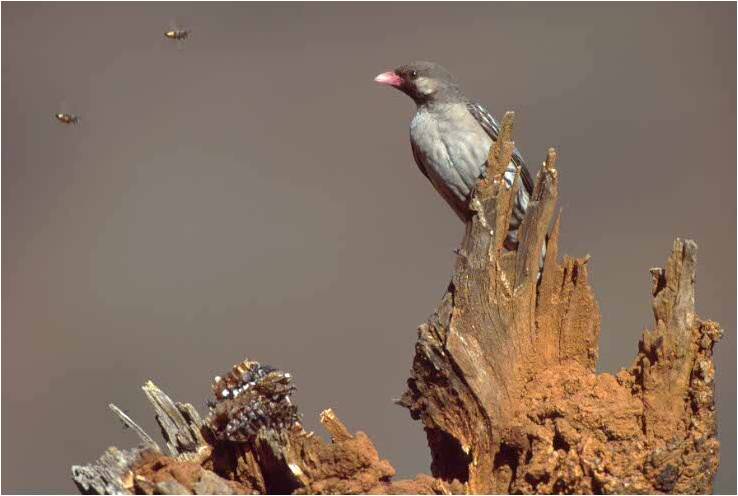
The Greater Honeyguide, Indicator indicator, is related to the family of woodpeckers and is native to sub-Saharan Africa.

This remarkable partnership between the Greater Honeyguide and humans is fairly complex and requires the active participation of both parties in order for it to work effectively. To begin it, African honey-gatherers first draw the attention of the bird when they set out on an expedition by using a distinctive whistle that can be heard from more than a 1 km away. This call, known as the 'Fuulido' among the Boran tribes of Kenya, is made by blowing air into closed fists, modified shells or hollow nuts and more than doubles their chances of encountering the bird. Once a Honeyguide has located humans that are interested in foraging for honey, it becomes excited and flits rapidly between perches that are close to the party while emitting a double-noted and persistent call. African honey-gatherers claim that this call signals that the bird knows of a nearby bee colony, which it will lead them to. Thereafter this behaviour, the Honeyguide flies away in a straight line for up to few minutes before returning. Once it has returned to the foraging party it sits on a conspicuous perch until the honey-gatherers approach it, at which point it flies off again in the same direction (while calling). In this manner, it leads the humans to the site of the colony with each flight getting shorter and each perch getting lower as the distance to the hive decreases. Once the Honeyguide has reached the site of the hive, it circles it and emits a lower 'indication call' that is softer, with a greater gap between notes to signal their arrival.

Researchers have found that this communication system is extremely successful and have calculated that by following the bird, African honey-gatherers can reduce their foraging times by 64% (Isack & Reyer, 1989)! Despite its obvious success and benefits to humans however, many scientists were once baffled as to why the system evolved in the first place. Mainly, because it would have been an evolutionary nightmare: with both counterparts to the system having to learn how to communicate with the other and what parts to play simultaneously... It is plausible however when you consider the fact that humans and Honeyguides have coexisted in Africa for millions of years, providing a long 'window' that this could have taken place in. Furthermore, the evolution of such a system makes sense logically. Humans benefit from following the Honeyguide since the bird leads them to bee colonies and saves them many hours that they could have spent fruitlessly searching for. Once at the nests, humans can break them open using tools and smoke (an old bee-keepers trick that makes bees very docile, effectively sending them to sleep) to extract the honey and thus, get a food reward. The Honeyguide benefits from leading humans to any nests that it has found since humans can break the nests much more easily than they can. Thus, they can get their own food reward (wax and larvae) without the risk of being stung. Thus, both parties directly benefit from participating in the arrangement and it should logically, be under positive selection pressure.

Many biologists argue that the communication system between humans and the Honeyguide actually evolved between the bird and the Honey Badger, Mellivora capensis, and that humans merely 'hijacked' their way into it. This is highly doubtful however, due to two main reasons. Firstly, Honeyguides are diurnal (active during the day) and Honey Badgers are nocturnal (active during the night) so the animals would rarely meet under natural circumstances and definitely not enough to allow such a sophisticated communication system to have evolved. Secondly, because no-one has ever seen a Honeyguide lead a Honey Badger to a bee colony nor are there any historical anecdotes of this occurring.

Interspecific communication systems such as this are very rare in nature and have only seldom evolved. This is mainly due to the fact that different species are usually in direct competition with each other for resources so would normally selfishly exploit such a system for their own ends and due to the difficulties in the genetics and learning that underlies such behaviours (which were mentioned earlier). Thus, the relationship between humans and the Greater Honeyguide is a remarkable feat of communicative engineering and is a superb example of the ingenuity of Nature.


Reference

Isack H. A. & Reyer H. U. (1989). Honeyguides and Honey Gathers: Interspecific Communication in a Symbiotic Relationship. Science 243, 1343-1346.

27 June 2012

Watching from the waters

The Nile crocodile, Crocodylus niloticus, is one of the most feared animals in the world and is undisputedly the most dangerous species of crocodilian to humans - being estimated to kill around 200 people each year. This is mainly due to its close proximity to our settlements and its indiscriminate diet - with it hunting anything that moves! Growing as long as 16 feet (5 metres) and weighing up to 225kg (500lb), the Nile crocodile can be found through central and south-east Africa and on the western shores of Madagascar. 

This is believed to be one of the largest specimens of Nile crocodile ever caught! Its huge size makes it no wonder why many Ancient Egyptians incorporated the beast into their belief system and worshipped Sobek, the crocodile god that lived in Crocodilopolis - a great city of crocodiles!

Probably one of the main reasons that the crocodile is such a proficient predator and is so lethal to humans is because it is a silent ambush predator - its flat body allows it to remain completely submerged, even in the shallow waters by river banks; and it has slightly raised nostrils and eyes that can be poked above the surface while keeping everything else hidden underwater, allowing it to see and breath virtually unnoticed. This allows the crocodile to get within yards of its prey (including humans), completely unnoticed and once it is ready, it lunges out of the water. Once the crocodile has lunged it is normally too late for its victim due to the speed of the attack and the animal is then crushed in the crocodile's vice-like bite and dragged into the water. After it has bitten an animal, Nile crocodiles (as with most crocodilians), have an overwhelming instinct to role - this is commonly known as 'death rolling' and, by spinning like a corkscrew, the crocodiles tear huge chunks of flesh out of their prey. This helps to compensate for their ineffective teeth, which are unusually blunt for a predator.

http://www.corbisimages.com/stock-photo/rights-managed/FL004379/nile-crocodile-eats-gazelle-kenya
A Nile crocodile that has caught a gazelle. Nile crocodiles can eat up to half their body weight at a time and their bite force has been measured to be as high as 5, 000 lbf (22N), which is like being hit by a very fast-moving truck! Like most crocodiles, N. niloticus has a primary and secondary bite where an individual bites its prey once and then re-bites it without relaxing their first bite, helping to drive its blunt teeth even further into the flesh of the animal.

Ambushing their prey in this manner means that they can remain motionless in the water for very long periods of time and so, can conserve enormous amounts of energy. Crocodilians can also reduce their energy expenditure even further by slowing down their breathing and reducing their metabolism using a sophisticated cardiac shunting system that diverts blood away from their heart. Although cardiac shunting mechanisms are found in many species of reptile none have one as advanced as crocodiles. This, along with the fact that they have the most advance heart physiology in the world, has led many scientists to believe that crocodiles were once endothermic (warm blooded) like mammals and birds! Such scientists believe that their warm blooded ancestors slowly evolved back into being ectotherms (cold blooded) when they began to ambush their prey from water since a cold blooded body-plan would be much more beneficial for such a strategy; mainly because it wastes much less energy than trying to maintain a body temperature that is hotter than the surrounding water - just think about how cold you get if you spend too long in a cool bath or pool!

Thus, crocodiles can remain even in fairly cool water for long periods of time and wait for a potential meal to come to them! This is usually when an animal ventures too close to the waters edge for a drink... Nile crocodiles don't even have to use their muscles to hold their head up so can save even more energy while they wait! Their lungs act as ballast tanks and when they are inflated with air, actually push the crocodiles snout and eyes up above the water level! In fact, crocodiles can slow down their energy expenditure so much that they can hold their breath underwater for up to 2 hours when they inactive; often, lying in little 'dens' that they've dug out of the riverbed with their arms.

Certain species of bird, such as the spur-winged plover (Vanelus spinosus), have been seen picking scraps of meat from between crocodile teeth. It is not known for certain whether the birds are merely 'running the gauntlet' to obtain food at great personal risk or whether crocodiles are allowing them to this; forming a mutualistic relationship where the birds are fed while keeping the crocodile's mouth and teeth clean.

Although Nile crocodiles often hunt via ambushing their prey, they can also hunt with a much more proactive and energetic approach - chasing after fish and eating them underwater. It is believed that Nile crocodiles prefer to eat larger terrestrial game that they hunt with surprise attacks preferentially and switch to smaller fish when they aren't available or during then night when their mammalian prey is less active. Nile crocodiles are thought to prefer to ambush mammals for two main reasons: firstly, since it is less energetically expensive as mentioned above; and secondly, because crocodiles are far-sighted underwater due to the closure of their protective nictitating, or 'third', eyelids. Closing their third eyelid helps to protect their eye from underwater debris but also bends the light that passes through it so that the lenses in their eye can't refract the light enough to focus on close-up objects. Obviously, this will severely reduce their ability to hunt underwater and hunting in such a manner would probably be impossible if they didn't have many sensory papillae around edge of their lower jaw. These papillae act a bit like whiskers in dogs and cats and are able to detect even very minute vibrations in the water, allowing the crocs to sense fish that are close to their mouth! Crocodiles use much more energy when hunting fish in such a manner and as a result, can only hold their breath underwater for about 15 minutes since their muscles require more oxygen.

Their ruthless ability to surprise their prey and the fact that they eat humans has undoubtedly earned the Nile crocodile a fearsome reputation as a heartless monster. Oddly however, this isn't true and Nile crocodiles are one of the few crocodilians that care for their young - with mothers watching over their nests from when they lay their eggs to when they hatch! Most crocodilians abandon their nests as soon as they have lain their eggs and leave their offspring to fend for themselves. Furthermore, many crocodilians are cannibalistic and will eat juvenile crocodiles so that they may actually kill their own young unknowingly...

The gender of crocodiles is determined by the temperature that the eggs are at during their incubation, with temperatures of 32 - 33C producing males. Anything warmer or cooler than this narrow temperature range produces females, which is of great concern to conservationist biologists since global warming may result in more females being born and less males! The small size of the baby crocodiles makes them very vulnerable to predation early in life, but as they grow bigger and, if all goes well, the crocodiles can live for up to 100 years!

The Nile crocodile then, is a brutal and ruthless predator that preferentially hunts by ambushing unsuspecting animals from water. It accomplishes this using a range of physiological and behavioural adaptations and techniques which allow them to get within yards of their prey, gliding through the water causing barely a ripple... Despite their danger to man and the polluting effects that our lifestyle has on the waters of their habitats, the Nile crocodile is thriving and is classified as being of 'Least Concern' by the IUCN. This is not surprising really, since crocodilians are ancient animals that even trod the world with the dinosaurs! Their famed resilience allowed them to survive through the catastrophe that killed off the once mighty dinosaurs; and maybe, will even mean that they will survive for long after man has disappeared...